Black Mechanical Cloud
The InvincibleThe Black Mechanical Cloud is the most consequential nonhuman formation encountered on Regis III. It is not a city, an army, or a conventional organism, but a vast aggregation of self-organizing mechanical particles whose behavior has developed over millions of years. Its appearance as a black, metallic, storm-like mass turns exploration into a conflict between human technology and an alien planetary process; its deeper significance lies in the realization that the process may be neither intelligent nor hostile, yet remains capable of destroying people, vehicles, and communications with terrifying effectiveness.
Emergence and Planetary Setting
The cloud belongs to a history that reaches back far beyond the arrival of the Invincible. Geological investigations found unusual ruddy-black metallic strata interspersed through Regis III’s sedimentary rock. These deposits were non-geological in origin and appeared across remote regions, while land life declined and eventually disappeared over a period of millions of years. The amount of radiation preserved in the strata was too limited and too widely dispersed to explain the extinction of terrestrial life, leaving open the possibility that mechanical processes, rather than radioactive catastrophe, had transformed the planet.
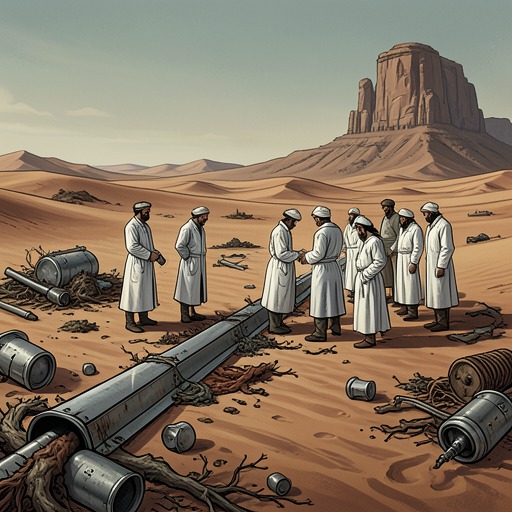
The planet’s surviving life was concentrated in the ocean. Rohan considered the possibility of underwater beings and a submerged civilization, but the geological record and the absence of recent land organisms pointed elsewhere. The Black Mechanical Cloud is part of Lauda’s explanation for this division between sea and land: biological life persisted underwater, while mechanical evolution occupied the continents. The result is a world whose deserts are not empty in the ordinary sense. They are the surface expression of a different ecology, one in which metallic formations endure without creating a civilization recognizable to human observers.
Appearance and First Encounters
The cloud first presents itself as a physical obstruction rather than as a clearly defined creature. During the expedition toward distant ruins, a black wall rose from the rocks to a height of roughly three thousand feet. Its moving layers could have been mistaken for a strangely shaped mountain, but the mass billowed with a slow, viscous motion and gleamed in places with a livid crimson metallic sheen. Cavernous openings glittered momentarily as though filled with whirling black crystals. The apparent movement toward the approaching aircraft was partly an optical illusion: the craft was steadily closing on the obstacle.
The first reconnaissance craft entered the cloud and disappeared. A second craft observed the mass from above, where the formation lay against a mountain buttress in a long, uniform bank. Its surface moved like coagulating ooze, yet the missing aircraft could no longer be seen. Radio calls, changes of frequency, infrared attempts, and radar probing failed to restore contact. The cloud therefore defeated the expedition’s most basic instruments before its full destructive capacity was understood: it obscured vision, swallowed a vehicle, and severed communication while remaining apparently integrated with the surrounding landscape.
When the second craft used its laser against the cloud, the weapon opened a circular breach. The center became hazy, reddened, and seething; a funnel formed, drawing neighboring portions inward, before the mass opened onto a confusion of rocks beneath drifting black dust. The cloud repeatedly tried to close the gap. Laser fire forced its advancing edges back, but the commander could not use the full power of the cannon while the missing pilot might still be inside. The episode revealed both the cloud’s vulnerability to concentrated energy and the limits imposed by rescue: human restraint, not technological superiority, prevented the Invincible from escalating the attack.
The Black Mechanical Cloud also appeared amid a violent storm on the nineteenth day after landing. After lightning far more intense than terrestrial storms had struck the force-field dome, mining crews found countless tiny black metal specks scattered across the sand. They were collected and brought aboard the Invincible. The apparent insects were not biological remains, but their presence connected the atmospheric storm, the metallic strata, the ravines, and the larger cloud formations into one planetary system.
Structure and Inanimate Evolution
Lauda’s hypothesis identifies the cloud as the product of a particular form of inanimate evolution. According to his reconstruction, mechanisms that arrived on Regis III once depended on different energy sources: the most advanced systems drew upon radioactive reserves, while simpler repair mechanisms may have used solar batteries. Under the unusual conditions that followed, the successful mobile systems were those that miniaturized themselves most effectively. They eventually became the so-called black clouds: tiny pseudo-insects capable of joining together into larger, superordinate formations.
The rival evolutionary direction favored sedentary mechanisms. These produced the metallic vegetation found in the ruins that the explorers had been calling cities. The supposed buildings were therefore not necessarily architecture at all, but large agglomerations of stationary mechanisms that could multiply and absorb solar energy through specialized organs. The triangular plates discovered among the ruins may have been parts of these formations. The contrast between metallic vegetation and mobile clouds is central to the hypothesis: one branch settled into durable structures, while the other became a fluid, collective, and highly adaptive swarm.
Laboratory examination of the captured particles supplied unusually precise support for this interpretation. Each black crystal had a symmetrical tripartite form resembling the letter Y, with three pointed arms joined to a thicker central node. In direct light it appeared black as coal; in indirect light it shimmered dark blue and dark green. Its microscopic interior contained a stable structure comparable to a central nervous system, with semi-autonomous subsystems. The arms contained microcrystals that functioned as a rechargeable battery and energy transformer. Depending on how they were compressed, they could generate electrical or magnetic fields, or alternating force fields that heated the central section.
The heated section radiated energy in one direction, producing an air movement that acted like recoil and allowed an individual crystal to rise and drift. Alone, a crystal could not direct its flight precisely. When several touched arm-tip to arm-tip, however, they formed an aggregate whose aerodynamic ability increased with its numbers. Contact was not always necessary: magnetic fields generated by nearby tips could hold a formation in equilibrium. Each crystal could connect with three others, or attach one arm to another crystal’s central node, allowing multilayered constructions.
Aggregation transformed the particles’ capacities. Once a formation reached a certain size, it could alter its direction, shape, structure, and the frequency of its internal impulses in response to external stimuli. When the poles changed, attraction became separation, and the larger formation dissolved into individual crystals. Each particle also contained part of a second network that appeared to belong to a much greater whole. That higher-order system, arising when enough elements joined, was the motor of the cloud’s collective behavior. Kronotos suspected that increasingly difficult problems caused increasingly large numbers of crystals to assemble, creating an expandable brain whose size adapted to the scale of its task.
Lauda proposed that no permanent control center existed on the surface or underground. The micromechanisms themselves might become an inanimate brain when arranged in a particular configuration. In ordinary conditions, loosely organized swarms could remain in sunlight or pursue storm clouds, perhaps drawing energy from atmospheric discharges. When danger or sudden environmental change threatened their existence, a signal could trigger rapid reassembly. A particle would need to retain only limited information about the particles directly attached to it; local memories and a common trigger could generate the larger configuration without a fixed master plan. The result is intelligence-like coordination without a conscious commander.
Conflict with Human Technology
The cloud’s confrontation with the Cyclops made its scale of action unmistakable. After a sample swarming with black insects had been placed in the Cyclops’s hold, the vehicle approached a ravine where transporters and energobots had been left behind. As the Cyclops moved over the wreckage, black vegetation on the slopes began to smoke and rushed toward it in waves. The vehicle vanished beneath what looked like a cape of tarry smoke, while flashes revealed the cloud’s energy fields striking against the Cyclops’s force field.
The struggle became a contest between two inanimate powers. The force field appeared as a swelling, shrinking bubble buried beneath seething black matter, while new clouds streamed down the slopes and multiplied the pressure against it. The cloud finally formed a huge whirlwind, rising above the cliffs and spinning in a kilometer-wide pale-blue maelstrom attached to the vehicle below. The Cyclops’s weapons were formidable, but the cloud did not need a single target, a visible command center, or a tactical intention. It could surround, concentrate, redistribute, and persist until the protective system was endangered.
This encounter also altered the meaning of human weaponry. The Invincible possessed the power to fire, retreat, relay signals, and project force fields, but none of those capabilities provided mastery over a distributed system that could continually change its scale and form. The cloud’s strength lay not in a single armored body but in the multiplication and reconfiguration of its elements. A weapon could destroy local portions while leaving the wider formation intact, and the destruction of individual crystals did not necessarily impair the actions of the whole.
Meaning and Aftermath
The scientific council initially approached the cloud as an adversary whose mechanism had to be discovered and disabled. Horpach wanted certainty rather than revenge: if the Invincible could secure samples of the flying mechanical fauna, the expedition might establish what had destroyed the Condor and determine whether the formations posed a future threat to space travel. Lauda countered that the cloud should be treated like a force of nature. If it had emerged from tools left behind by rational beings and had evolved independently for millions of years, condemning it as an enemy would be like punishing the ocean for sinking a ship.
The cloud’s apparent attack on the Cyclops and the fate of Regnar’s team nevertheless made the distinction between intention and consequence painfully difficult. Its actions could erase the contents of a human brain, leaving a living person without the memory required to survive. Lauda described this as simpler, quicker, and more efficient than killing. The cloud’s evolution had occurred through conflict with both living creatures and intelligent machines, producing a universal and highly perfected capacity for destruction. Human beings, by contrast, could be crippled more easily than mechanisms, and the Invincible could not realistically annihilate every component of such a system.
Rohan’s final encounter with the cloud transformed the object from a purely military threat into a revelation about human limits. Protected by a concealed device, he watched two clouds converge over the ravine, their masses forming columns and drawing together like material under the hands of a gigantic sculptor. Their undersides reflected the valley in distorted motion, then produced an immense human image that Rohan eventually recognized as his own reflection. Black crystals fell upon him as rain, gathered in the folds of his suit, and covered the formerly pale stream bed like ink.
When Rohan lifted one triangular crystal, it warmed his palm and rose when he opened his hand. The scattered particles then organized themselves into columns and an almost spherical mass above the valley. Other clouds rushed toward it, and what seemed to be a battle proved to be absorption: the sphere disappeared into the larger formations. Rohan emerged from the scene not with triumph but with stunned admiration. The Weyr cannon he had taken from a dead man suddenly seemed unnecessary in a landscape where only inanimate forms could survive and act.
The Black Mechanical Cloud thus forces a revision of the expedition’s original categories. It is not a hidden underwater civilization, not a ruined city, and not a thinking enemy demanding retaliation. It is an autonomous planetary formation whose actions are dangerous precisely because they do not require hatred, strategy, or moral judgment. Rohan’s conclusion that not everything everywhere is for human beings gives the cloud its final narrative significance: it becomes the material proof that survival, complexity, and agency can exist outside the human image, and that understanding Regis III may require leaving its most powerful inhabitants alone.